


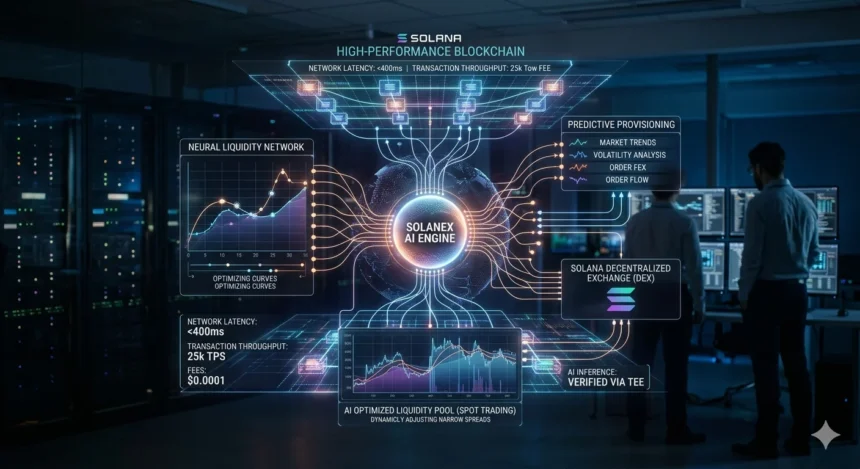
The evolution of decentralized finance has reached a pivotal juncture where the raw speed of blockchain networks is finally meeting the cognitive capabilities of machine learning. Within the high-performance ecosystem of the Solana network, a new class of protocols is emerging to address the long-standing inefficiencies of automated market makers. Solanex AI stands at the forefront of this technical shift, representing an attempt to move beyond the rigid mathematical formulas that have defined decentralized exchanges since their inception. By integrating neural network models directly into the liquidity management process, the platform seeks to create a more fluid and responsive environment for digital asset exchange. This transition from static smart contracts to intelligent autonomous systems marks a significant milestone in the broader narrative of decentralized technology, offering a glimpse into how global markets might function when every transaction is optimized by real-time data analysis.
Algorithmic Liquidity and Predictive Provisioning
At the heart of any decentralized exchange is the challenge of liquidity management. Traditional platforms rely on a constant product formula which, while revolutionary for its simplicity, often fails to account for the nuances of market volatility and shifting demand. This results in slippage, where the price of an asset changes significantly during the execution of a trade, particularly for larger orders. Solanex AI attempts to solve this through what can be described as neural liquidity networks. Instead of following a fixed curve, the protocol utilizes machine learning algorithms trained on vast datasets of market microstructure. These models are designed to recognize patterns in trading volume and price action, allowing the system to anticipate where liquidity will be needed most before a surge in demand actually occurs. By predicting short-term volatility, the protocol can theoretically concentrate capital within active price ranges, thereby narrowing spreads and ensuring that users receive prices much closer to the global market average.
The Mechanical Necessity of Low Latency Infrastructure
The technical marriage between artificial intelligence and the Solana blockchain is not a matter of convenience but a mechanical necessity. For a machine learning model to effectively optimize trading in real-time, it requires an execution layer with extremely low latency and high throughput. Solana provides this environment through its unique proof-of-history consensus mechanism and its ability to process thousands of transactions per second. With settlement times often dipping below four hundred milliseconds, the network allows AI agents to perform the rapid calculations and micro-adjustments necessary to rebalance liquidity pools without being hindered by the bottlenecks common on slower legacy blockchains. This high-frequency environment is essential for the self-learning aspect of the protocol, as it provides a continuous stream of data that the neural networks use to refine their predictive accuracy over time.
Security Primitives and Verifiable Computation
Beyond the immediate benefits of price optimization, the integration of AI into decentralized finance introduces a new layer of architectural complexity regarding security and verification. One of the primary concerns in any autonomous system is ensuring that the decisions made by an AI model are both accurate and untampered with. To address this, the infrastructure often utilizes trusted execution environments or cryptographic proofs to verify that a specific trade or liquidity shift was indeed triggered by the authorized machine learning model. This focus on verifiable computation is crucial for maintaining the trustless nature of decentralized protocols. It ensures that while the system is intelligent and autonomous, it remains transparent and bound by the security primitives of the underlying blockchain. This transparency is a core tenet of the technology, providing a clear audit trail for every action taken by the AI agents within the ecosystem.
Strategic Shifts in Professional Content Standards
For those analyzing these developments from a content strategy or technical editorial perspective, the focus remains firmly on the innovation of the underlying infrastructure rather than speculative market behavior. The narrative of Solanex AI is essentially a story about the maturation of decentralized tools. We are seeing a shift away from primitive decentralized finance, which was defined by simple swaps and high-risk yield farming, toward a more sophisticated institutional-grade framework. This new framework prioritizes efficiency, security, and the reduction of waste in the form of slippage and impermanent loss. By discussing these advancements through the lens of technical architecture and algorithmic design, it is possible to explore the cutting edge of the industry while maintaining a professional and objective tone that emphasizes utility over hype.
Understanding the shift toward these intelligent systems is becoming a core part of the strategic edge and essential skills for the modern technology solutions professional, as the ability to navigate the intersection of machine learning and blockchain architecture defines the next generation of digital leadership.
Democratization of High-Frequency Trading Tools
The broader implications of this technology extend into how we perceive the future of global asset management. As machine learning models become more deeply integrated into the fabric of financial protocols, the role of the human participant begins to change. Instead of manually navigating complex trading interfaces or attempting to time market fluctuations, users can interact with systems that are inherently designed to protect them from the most common pitfalls of decentralized trading. This democratization of high-frequency trading tools, which were once the exclusive domain of major financial institutions, represents a significant shift in the balance of power within global markets. It suggests a future where decentralized protocols are not just alternatives to traditional finance but are actually superior in their ability to provide fair and efficient price discovery for all participants.
While many users are currently focused on the best features to look for in trading apps for active investors, the underlying shift toward AI-driven protocols like Solanex represents the next level of that evolution, moving from simple user interfaces to intelligent, autonomous execution layers.
Sustainability and Economic Efficiency in Automated Systems
Furthermore, the environmental and economic sustainability of these systems is a critical factor in their long-term viability. The cost efficiency of the Solana network, where transaction fees are consistently a fraction of a cent, allows for a level of granular optimization that would be cost-prohibitive elsewhere. This means that AI models can perform thousands of small, precise adjustments to liquidity positions throughout the day without eroding the value of the pools they are meant to manage. This economic model supports a more sustainable form of decentralized finance, where the value created by intelligent optimization is not immediately lost to network congestion or exorbitant gas fees. It creates a feedback loop where efficiency leads to lower costs, which in turn attracts more liquidity, further improving the performance of the AI models.
Future Trajectories of Decentralized Intelligence
The emergence of AI-driven protocols like Solanex on high-speed blockchains represents a transformative phase in the digital asset landscape. By moving toward adaptive, data-driven liquidity management, the industry is overcoming the technical hurdles that have historically limited the growth of decentralized exchanges. The focus on neural networks, low-latency execution, and verifiable security infrastructure points toward a future where financial protocols are both more intelligent and more resilient. For observers of this space, the primary interest lies in how these diverse technologies machine learning, cryptographic security, and high-performance blockchain architecture are being woven together to create a more efficient global financial system. As these systems continue to evolve and learn from the markets they inhabit, they will undoubtedly set new standards for what is possible in the realm of decentralized technology.