

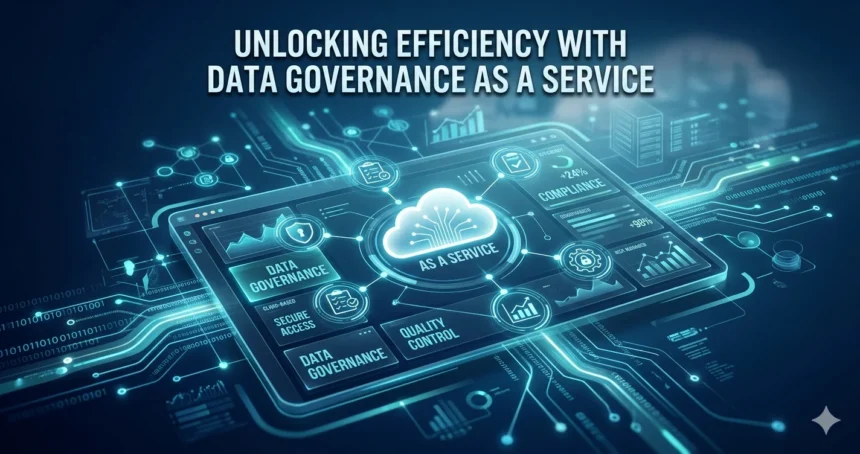
In today’s data driven world, organizations face mounting pressure to manage vast amounts of information securely and effectively. Data governance as a service emerges as a practical solution, offering businesses a way to streamline their data operations without the heavy lift of building everything from scratch. This approach delivers expert tools, processes, and oversight through specialized providers, ensuring data remains accurate, compliant, and ready for decision making.
Traditional data governance often feels overwhelming, requiring significant internal resources and expertise. Data governance as a service changes that by providing scalable support tailored to your needs. Companies turn to it for everything from policy enforcement to quality checks, gaining agility in a landscape where data volumes double every few years. As reliance on data grows, this service model helps bridge gaps, making complex management accessible even for mid sized teams.
Understanding the Foundations of Data Governance as a Service
At its core, data governance as a service refers to outsourcing the operational side of data stewardship to external experts. Providers handle the day to day tasks like cataloging assets, enforcing standards, and monitoring compliance, while your team retains strategic control. This partnership model leverages cloud based platforms and automation, reducing the need for on premise infrastructure.
Think of it as hiring a specialized team that integrates seamlessly with your operations. They start with a thorough assessment of your current data landscape, identifying pain points such as inconsistent formats or access issues. From there, they implement frameworks that standardize definitions and workflows. The result is a unified data environment where insights flow reliably, free from silos that plague many organizations.
This service also emphasizes proactive measures. Regular audits and real time monitoring catch issues early, preventing costly errors downstream. For instance, in industries dealing with customer information, ensuring privacy standards from the outset avoids regulatory headaches later. Data governance as a service thus acts as a force multiplier, enhancing trust in your data foundation.
Why Organizations Are Shifting to Data Governance as a Service
The shift toward data governance as a service stems from practical realities. Internal programs demand time, budget, and skilled personnel, which not every company has in abundance. Providers bring proven methodologies and cutting edge tools, accelerating maturity levels that might otherwise take years to achieve.
Cost efficiency stands out as a major draw. Instead of hiring full time staff or investing in custom software, you pay for what you use, scaling up during peaks like system migrations, much like how using proposal management software streamlines your business processes. This flexibility suits dynamic businesses adapting to market changes. Moreover, external specialists stay ahead of evolving regulations, updating your setup without internal overhauls.
Another compelling reason involves risk reduction. Poor data practices lead to breaches, fines, or misguided strategies, but data governance as a service embeds safeguards like encryption protocols and access controls. Organizations report faster analytics cycles and higher data quality scores after adoption, translating to tangible returns. In essence, it democratizes advanced governance, leveling the playing field for smaller players.
Key Components That Make Data Governance as a Service Effective
Successful data governance as a service revolves around several interconnected elements. Metadata management forms the backbone, cataloging data origins, transformations, and usage to provide full visibility. Providers use automated tools to tag and track assets, making discovery intuitive for users across departments.
Data quality monitoring follows closely, with continuous validation against predefined rules. This catches duplicates, incompleteness, or anomalies in real time, maintaining reliability. Integration with existing systems ensures smooth data flows, whether from databases, applications, or third party sources.
Compliance and security features round out the offering. Automated lineage tracking shows how data moves and changes, simplifying audits. Role based access ensures only authorized personnel interact with sensitive information. Together, these components create a robust ecosystem where data governance as a service delivers ongoing value.
Implementing Data Governance as a Service in Your Organization
Getting started with data governance as a service begins with clear objectives. Define what success looks like, whether improved reporting accuracy or faster regulatory responses. Engage providers who align with your industry, as their experience shapes customized roadmaps.
The onboarding process typically spans discovery, design, and deployment. During discovery, experts map your data estate, highlighting strengths and gaps. Design phases craft policies and select tools, often leveraging AI for smarter automation. Deployment rolls out changes incrementally, minimizing disruption while training your team, especially when paired with strategies to define business processes to automate for operational efficiency.
Ongoing management involves regular check ins and performance metrics. Dashboards provide visibility into key indicators like completeness rates or policy adherence. Adjustments evolve with your needs, ensuring the service remains relevant. Many organizations see initial wins within months, building momentum for broader adoption.
Real World Benefits of Adopting Data Governance as a Service
Businesses embracing data governance as a service often uncover surprising advantages. One finance firm reduced reporting errors by half after implementing standardized quality checks, speeding up month end closes. Another retail operation gained deeper customer insights through cleaner, integrated data sets, boosting personalization efforts.
From a strategic angle, reliable data fuels innovation. Analytics teams spend less time cleaning and more on modeling, uncovering trends that drive growth. Leadership gains confidence in metrics, enabling bolder decisions that can transform areas like customer support through implementing contact centers. Over time, this fosters a data literate culture where governance becomes second nature.
Quantifiable gains extend to efficiency. Automation frees resources previously tied to manual tasks, with some reports showing twenty percent productivity lifts. Scalability shines during expansions, as the service absorbs new data streams effortlessly. Ultimately, data governance as a service transforms data from a liability into a competitive asset.
Overcoming Common Challenges with Data Governance as a Service
No transition comes without hurdles, yet data governance as a service mitigates many. Resistance to change ranks high, as teams fear added oversight. Providers counter this with change management support, emphasizing benefits through quick wins and training.
Integration complexities arise with legacy systems, but modern platforms offer connectors for popular tools. Starting small, with pilot projects on critical datasets, builds proof of concept and refines approaches. Vendor selection matters too, favoring those with strong references and flexible contracts.
Sustainability requires commitment beyond setup. Regular communication between your team and the provider keeps priorities aligned. Metrics tracking ensures accountability, while periodic reviews adapt to shifts like new tech or regulations. With thoughtful planning, challenges become stepping stones to mastery.
The Future of Data Governance as a Service
Looking ahead, data governance as a service will evolve with advancing technologies. AI and machine learning promise smarter automation, predicting issues before they surface. Integration with edge computing and IoT expands scope, governing data at the source for real time accuracy.
Regulatory landscapes will drive further sophistication, with global standards demanding adaptive compliance. Providers will offer predictive analytics, forecasting governance needs based on usage patterns. Hybrid models blending service with internal tools will proliferate, giving businesses granular control.
As data becomes the lifeblood of operations, data governance as a service positions organizations for resilience. Early adopters gain edges in trust, speed, and innovation, setting benchmarks for peers. Embracing it now prepares you for a future where data excellence defines success.
Disclaimer: This article provides general information about data governance as a service and is intended for educational purposes only. It does not constitute professional advice, legal counsel, or financial recommendations. Organizations should consult qualified experts before implementing data governance strategies or selecting service providers. The author and publisher disclaim any liability for decisions made based on this content.