


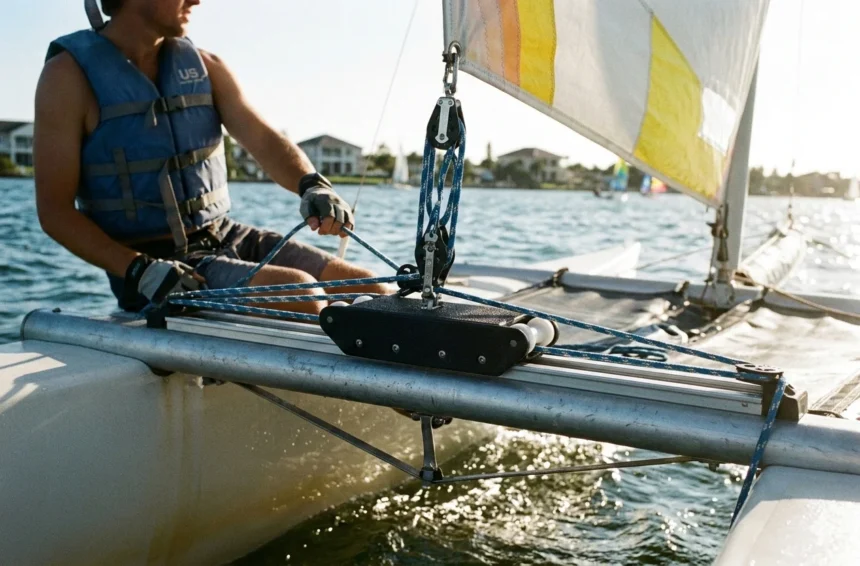
The Prindle 16 remains a legendary fixture in the American beach catamaran scene. From the breezy coasts of Florida to the gusty lakes of the Inland Empire in California, this boat has maintained a cult following for over four decades. While many sailors focus on sail trim or hull polish, the true secret to mastering this boat lies in a single mechanical system located on the rear beam: the Prindle 16 Traveller. This system is essentially the gas pedal and the steering stabilizer of your catamaran. Understanding how it works and how to keep it sliding smoothly is the difference between a frustrating day of fighting the wind and a high-speed session of controlled flight.
Anatomy of the Prindle 16 Traveller System
To understand the Prindle 16 Traveller, you must first look at the rear crossbar of the boat. Unlike many modern boats that use external tracks bolted onto the deck, the Prindle 16 features an elegant integrated aluminum track built directly into the rear beam. This design keeps the profile low and the weight centered. The heart of the system is the traveller car, a compact unit equipped with specialized rollers that allow it to move under extreme tension. This car serves as the mounting point for your mainsheet blocks. Because the Prindle 16 is a powerful boat with a significant sail area, the traveller car must endure hundreds of pounds of upward force while still being able to slide laterally with minimal effort.
The rigging of the traveller typically involves a control line that runs from the car to a set of cleats, often located near the center of the beam or out by the hulls. In the United States, you will find two common ways to rig this. Some sailors prefer a bungee-return system that automatically pulls the car back to the center during a tack, while others prefer a continuous loop that gives them manual control over the car’s position at all times. Regardless of the rigging style, the goal is the same: to move the base of the mainsail across the width of the boat to change the angle of attack relative to the wind.
Prindle 16 vs Hobie 16 The Traveller Debate
In any American boat park, you are likely to hear a debate between Prindle owners and Hobie sailors. One of the biggest points of contention is the traveller design. The Hobie 16 uses a simple plastic or metal “slug” that slides inside a track. While functional, these often bind up under a heavy load, requiring the sailor to “kick” the traveller to get it to move. The Prindle 16 traveller car is a much more sophisticated piece of engineering. It utilizes captive rollers that significantly reduce friction. This allows a Prindle sailor to “dump” the traveller much faster than a Hobie sailor during a dangerous gust. This mechanical advantage is one of the reasons the Prindle 16 is often cited as a more forgiving boat for solo sailors or those navigating the unpredictable winds of the Gulf Coast.
Performance Tuning How to Use Your Traveller Like a Pro
Mastering the traveller is about understanding the relationship between power and sail shape. When you are sailing upwind and trying to “point” as high as possible, you generally keep the traveller car near the centerline of the boat. This keeps the sail tight and flat, allowing you to slice through the wind. However, as the wind speed increases, the boat will start to “heel” or lift a hull too high. Instead of letting out the mainsheet, which would cause the top of the sail to twist and lose its aerodynamic efficiency, you should instead slide the traveller car a few inches toward the leeward hull. This change in angle depowers the boat while keeping the sail shape perfect, allowing you to maintain high speeds without the fear of capsizing.
When you turn downwind or onto a “reach,” the traveller becomes even more important. By sliding the car all the way out to the end of the track, you allow the sail to open up. This creates a more effective “pocket” for the wind and prevents the boat from wanting to round up into the wind. Experienced Prindle racers often describe the traveller as their primary tool for balance. If the tiller feels too heavy or the boat feels like it wants to trip over its own bows, a quick adjustment of the traveller is almost always the solution. It provides a level of granular control that simply isn’t possible by using the mainsheet alone.
Common Issues and The Prindle Gremlins
Because most Prindle 16s currently on the water are several decades old, the traveller system often suffers from what sailors call “The Gremlins.” The most common issue is salt and sand infiltration. Since the traveller sits right on the rear beam, it is constantly doused in spray. When that water evaporates, it leaves behind salt crystals that act like sandpaper against the aluminum track and the plastic rollers. Over time, this creates “dead spots” where the car gets stuck. Another frequent problem is the degradation of the internal sheaves. These small pulleys inside the car are often made of vintage plastics that become brittle after years of exposure to the intense UV rays found in places like Southern California or Florida.
Furthermore, the aluminum track itself can undergo a process called pitting. This happens when the protective anodized coating of the aluminum wears away, allowing oxygen and salt to eat into the metal. If you feel a “crunchy” sensation when moving your traveller, it is likely that the track is pitted or the rollers have developed flat spots. Ignoring these issues can lead to a jammed traveller at the worst possible moment, such as during a high-speed gybe or a sudden squall. Regular inspection of these components is a mandatory part of owning a vintage catamaran.
Step by Step Restoring a Vintage Prindle 16 Traveller
Restoring a Prindle 16 traveller is a rewarding weekend project that can breathe new life into an old boat. The first step is removing the end caps from the traveller track. Be warned that these screws have likely been in place for thirty years and are prone to stripping. Using a high-quality penetrating oil and a bit of heat is often necessary. Once the caps are off, you can slide the car out of the track for inspection. In the, replacement rollers and sheaves are still available through specialty shops like Murrays Sports or Salt City Sailing. Replacing the old plastic rollers with new high-density versions will immediately make the boat feel decades younger.
While the car is off, you should address the track itself. If there is significant oxidation, a light sanding with very fine wet-and-dry sandpaper followed by a thorough cleaning with white vinegar can smooth out the surface. When reassembling the system, it is vital to use a barrier cream like Tef-Gel or Lanocote on any stainless steel screws that go into the aluminum beam. This prevents “galvanic corrosion,” which is the chemical reaction between two different metals that causes them to weld themselves together over time. A properly restored traveller should be able to slide from one side of the boat to the other with just a gentle push of your finger.
Essential Parts Suppliers for Your Prindle 16
Finding replacement parts for a legacy catamaran like the Prindle 16 can feel like a treasure hunt. Since the manufacturer is no longer in business, American sailors rely on a handful of specialized outfitters that have kept the “fast glass” community alive. The following suppliers are the gold standard for sourcing traveller rollers, sheaves, and rigging lines in the United States.
Murrays Sports based in California is widely considered the primary hub for Prindle parts. They carry the specific traveller car rollers and the stainless steel axles that frequently corrode over time. If you are looking for the exact dimensions for a Prindle 16 traveller car rebuild, their catalog is the most comprehensive resource available. They also stock the specific end caps for the rear beam track which are notorious for cracking after decades of UV exposure.
Salt City Sailing is another excellent resource, particularly for sailors on the East Coast or in the Midwest. They specialize in performance beach cats and often have “new old stock” or high-quality aftermarket alternatives for Prindle hardware. They are particularly helpful if you are looking to upgrade your traveller control lines to modern low-stretch materials like New England Ropes or Samson Rope.
West Marine or local chandleries are your best bet for the “consumables” of your traveller system. While they may not carry Prindle-specific molded parts, they are the go-to source for the Tef-Gel, Lanocote, and McLube dry lubricants mentioned earlier. You can also find high-quality stainless steel shackles and Harken or Ronstan cam cleats here if you decide to modernize your traveller control setup.
The Seasonal Prindle 16 Traveller Maintenance Schedule
To keep your traveller sliding like a modern racing machine, you should follow a structured maintenance routine. This prevents the “seizing” of metal parts and ensures your safety during high-wind maneuvers.
The Post-Sail Routine involves a thorough fresh water rinse of the entire rear beam. After sailing in salt water, salt crystals will form inside the traveller car housing. Use a high-pressure hose to spray directly into the rollers. While the track is wet, slide the car back and forth several times to flush out any trapped sand or grit. This simple two-minute habit can double the lifespan of your plastic rollers.
The Monthly Inspection should focus on the tension and condition of the traveller control lines. Check the areas where the line sits in the cleats, as this is where “compression flat spots” and UV rot usually begin. If the line feels stiff or “crunchy,” it is time to soak it in a bucket of fresh water with a small amount of fabric softener or replace it entirely. You should also check the security of the traveller track end caps to ensure no screws have vibrated loose.
The Annual Deep Clean is best performed at the start of the sailing season. This involves removing the traveller car from the track entirely. Clean the interior of the aluminum track with a Scotch-Brite pad and mild soap to remove any oxidation. Inspect the rollers for “flat spots” which occur if the car has been sitting in one position under high tension for too long. Apply a fresh coat of dry Teflon lubricant to the track and the roller axles before reassembling.
The Five-Year Overhaul is when you should consider a full hardware replacement. Even if they look okay, plastic rollers and sheaves become brittle over five years of American sun exposure. Replacing the rollers and the traveller line every five years is a cheap insurance policy against a mechanical failure in the middle of a lake or ocean. This is also the time to check the rivets or bolts attaching the traveller track to the beam for any signs of “slop” or movement.
A Comprehensive How To Guide for Replacing Your Prindle 16 Traveller Rollers
Restoring the smooth action of your Prindle 16 traveller is one of the most satisfying maintenance tasks you can perform. When the rollers are flat or the bearings are seized, moving the sail feels like dragging a heavy anchor across a parking lot. However, with the right tools and a systematic approach, you can return your traveller car to its factory glory. Before you begin, gather a few essential tools that are standard in most American toolboxes. You will need a set of needle nose pliers, a small flat head screwdriver, a hammer, and a thin metal punch or a sturdy nail. Because you are working with small parts over a boat that is likely parked on grass or sand, it is a very good idea to perform this surgery over a large light colored towel so that dropping a tiny stainless steel pin does not result in a lost part.
The first step in the process is removing the traveller car from the integrated track on the rear beam. Start by unscrewing the end caps located at either end of the aluminum track. These are typically held in place by two small stainless steel screws. If your boat has been used in saltwater, these screws might be stubborn. Apply a small amount of penetrating oil and let it sit for ten minutes before attempting to turn them. Once the end caps are removed, you can slide the traveller car out of the track. Take this opportunity to inspect the inside of the beam for any debris or hidden wasp nests which are a common find in boats stored in boat yards during the off season.
With the car on your workbench, you will see the axles that hold the rollers in place. On a standard Prindle 16 car, these axles are often held in by small tension clips or are press fit pins. Use your needle nose pliers to carefully remove the clips. If the pins are stuck, use your punch and a light tap from the hammer to drive the axle out of the car body. As the axle slides out, the old roller will drop free. You will likely notice that the old roller is no longer perfectly round. Years of the mainsheet pulling upward while the car was cleated in one position creates a flat spot on the plastic that causes the car to jump and skip rather than roll.
Before installing your new rollers from a supplier like Murrays Sports, take a moment to clean the stainless steel axles. If they show signs of rust or scaling, you can buff them with a bit of fine steel wool until they are shiny and smooth. When you are ready to assemble, slide the new roller into the car housing and push the axle back through the center. If you are using new axles, make sure they are flush with the sides of the car so they do not rub against the aluminum track once reinstalled. This is the perfect time to apply a tiny drop of dry lubricant to the axle. Do not use grease here, as it will only attract grit once you are back on the beach.
The final stage is reinserting the car into the track. Before you slide it back in, wipe down the inside of the rear beam track with a clean cloth to remove any leftover salt or old lubricant. Slide the car in and move it back and forth several times to ensure it glides without any catching or clicking. Once you are satisfied, replace the end caps and tighten the screws. When you next hit the water, the difference will be immediate. You will find that you can adjust your sail with a light flick of the wrist, allowing you to react to wind shifts faster and sail your Prindle 16 with much more precision and confidence.
Modern Upgrades for the Prindle 16
For those who want to take their Prindle 16 to the next level, there are several modern upgrades worth considering. Many sailors choose to replace the original “Clamcleats” with modern ball-bearing cam cleats. These provide a much more secure grip on the traveller line and allow for easier release under load. Another popular modification is the addition of a “shackle-less” connection between the traveller car and the mainsheet blocks. By using a high-strength Dyneema soft shackle, you can reduce the “clanking” noise of metal on metal and save a small amount of weight at the same time.
Some high-performance sailors even go as far as retrofitting modern windward-sheeting traveller cars from manufacturers like Harken or Ronstan. While this requires some custom drilling and mounting, it allows the sailor to pull the traveller car to the windward side without having to uncleat the leeward side first. This is a game-changer for racing, as it allows for much faster tacks and better pointing coming out of a turn. However, for most hobbyists, a well-maintained original system is more than sufficient for a day of “flying a hull” on the local bay.
Safety and Maintenance Checklist
Maintaining your Prindle 16 traveller is a matter of consistency. After every sail in saltwater, you must rinse the track and the car with fresh water. This is the single most important thing you can do to prolong the life of the system. Once or twice a season, you should apply a dry lubricant to the track. It is crucial to avoid using heavy greases or oils, as these will actually attract sand and grit, turning your lubricant into a grinding paste. Instead, use a specialized dry Teflon spray or a product like McLube.
Before you head out on the water, always check the traveller control lines for signs of “chafe” or UV damage. These lines are under constant tension and are often dragged across the rough non-skid surface of the hulls. If a traveller line snaps while you are out in heavy wind, the car will slam to the end of the track with incredible force, which can damage the beam or even cause a capsize. Keeping a spare length of high-quality yacht braid in your gear bag is a smart move for any Prindle owner.
Keeping the Legend Alive
The Prindle 16 is more than just a boat; it is a piece of American sailing history. It represents an era of design where speed and simplicity were perfectly balanced. By taking the time to understand and maintain your Prindle 16 traveller, you are ensuring that this classic catamaran stays on the water for another generation to enjoy. A smooth-sliding traveller makes the boat feel responsive and safe, allowing you to focus on the joy of the wind and the waves rather than struggling with sticky hardware. Whether you are racing against modern boats or just cruising with friends, a well-tuned traveller is your best friend on the water.
Frequently Asked Questions About the Prindle 16 Traveller
Can I use a Hobie 16 traveler car on my Prindle 16 track?
This is a very common question among new owners who find themselves at a local marine swap meet. Unfortunately, the answer is no. While both boats are sixteen-foot catamarans, their traveler systems are designed very differently. The Hobie 16 uses an external track or a different internal profile that is not compatible with the captive roller system found on a Prindle. Attempting to force a different car into your Prindle track will likely result in permanent damage to the aluminum beam. It is always better to wait for the correct Prindle-specific parts to ensure your safety on the water.
How tight should the traveler control lines be?
The tension of your traveler lines is a matter of personal preference, but there is a sweet spot you should aim for. If the lines are too loose, the car will “slop” around, making it difficult to maintain a consistent sail shape. If they are too tight, they can create unnecessary friction and make it hard to release the car quickly in a gust. Most experienced Prindle sailors keep just enough tension so that there is no visible slack in the line, but the car can still move freely when the cleat is opened. If you use a bungee return system, make sure the bungee is strong enough to pull the car back to center without being so stiff that it fights you when you try to move the car outboard.
What is the best way to clean a salt-encrusted traveler track?
If you have just purchased a used Prindle that has been sitting near the ocean, the track might be covered in a white, crusty oxidation. The best way to handle this without damaging the aluminum is to use a mixture of warm water and white vinegar. The mild acidity of the vinegar will help break down the salt and calcium deposits. Use a soft-bristled brush to scrub the inside of the track. Avoid using heavy wire brushes or harsh chemicals like bleach, as these can strip the anodized coating off the aluminum and lead to even faster corrosion in the future.
Why does my traveler car get stuck when I am out on a reach?
When you are sailing on a reach, there is a tremendous amount of sideways and upward force on the traveler car. If your car is sticking only when you are under sail, it usually means your rollers have developed flat spots or the internal bearings are failing. When the boat is on the trailer, the car might feel fine because there is no load on it. However, once the mainsheet is tight, those flat spots “lock” into the track. This is a clear signal that it is time for a roller replacement.
Is it safe to sail my Prindle 16 if the traveler is jammed?
Sailing with a jammed traveler is not recommended, especially in the gusty conditions common in many coastal areas. The traveler is your primary safety valve for depowering the boat. If you cannot move the car to leeward during a sudden increase in wind, your only option is to release the mainsheet, which can be slower and less effective. A jammed traveler also puts uneven stress on the rear beam and the mainsheet blocks. It is far better to spend an afternoon on the beach fixing the system than to risk a capsize or a broken mast out on the water.
About the Author
The author is a lifelong catamaran enthusiast with a passion for the fast glass era of sailboat design. Having spent countless afternoons chasing the wind along the American coastline, they have developed a deep appreciation for the engineering and tactile feel of vintage beach cats like the Prindle 16. For them, there is no greater satisfaction than taking a weathered, sun-bleached boat from a backyard and restoring it to its former glory.
Their approach to sailing is rooted in the belief that you do not need the newest or most expensive equipment to have an incredible experience on the water. Instead, it is about understanding the mechanics of your boat and knowing how to tune systems like the Prindle 16 traveller to handle whatever the day throws at you. When not out flying a hull or tinkering in the boatyard, they can be found sharing tips with the local sailing community and encouraging the next generation of sailors to keep these legendary catamarans cutting through the waves.